 Hill Country Desk
A Retired Train Dispatcher Lays a Peach Bottle's Label on a Twenty-Four-Hour Timetable
Onnit's Alpha BRAIN Focus Shot is a small peach drink with 50 milligrams of caffeine and six other lines on its panel. I set its label out hour by hour, from the refrigerator door to bedtime.

This is a paid advertisement. Sponsored by iHerb, LLC.

Leland Roe is the pen name of this desk.
Everything on this page about the bottle comes from the retailer's listing, the photographs of the carton on that listing and the maker's own product page, all read in September 2026.
This page quotes no customer reviews, and the reason is given in its own section further down.
For thirty-four years I wrote timetables for a freight railroad, and a timetable has one honest rule: every train gets a time, and no two trains get the same track at the same minute.
So when a neighbor on the hill handed me a carton of small peach bottles and asked whether the back of it meant anything, I did not read it like a label.
I read it like a schedule, because that is what it is: one bottle every twenty-four hours, shaken, cold, and never at bedtime.
This page lays that schedule out hour by hour, from the refrigerator door the night before to the last light in the kitchen.
Each line of the panel gets the hour where it belongs.
Most labels bury their clock in the fine print.
This one prints it plainly, and that made my job easier than usual.
A timetable is not a promise that a train will be fast.
It is a promise about when, how often and on which track, and that is exactly the kind of promise a label can keep.
One bottle, once in twenty-four hours, and never at bedtime.
Those three rules are the whole frame of this page.
Everything else, the caffeine, the tea compound, the choline compound, the mushroom, the club moss and the two vitamins, runs inside that frame or it does not run at all.
The bottle is sold on iHerb, a large online retailer based in Irvine, California, and the carton says it was made for Onnit Labs of Austin.
It is a dietary supplement in the form of a drink, which puts it on the same shelf as the capsules and powders, not beside the soda.
The front of the carton says it supports memory and focus.
I will come back to that line near the end, because the maker's own website does not say quite the same thing about this bottle.
Here is where this reading lands, so nobody has to go the whole distance to find out.
The caffeine is a real dose with a real, short effect on alertness, and it has to be counted with your coffee.
Two of the other lines sit at the doses of small trials, one sits at a small fraction of its trial, and one belongs at the pharmacy counter before it belongs in your morning.
And the retailer's page shows two different panels for this one product.
That alone is worth the length of this page, because it changes what you should read when the carton reaches your door.
Thirty-Four Years of Timetables, and the One Rule From Every One of Them
A freight railroad runs on paper long before it runs on steel.
Before a single car moves, somebody sits at a desk and decides what goes where, when, and what has to wait.
I was that somebody for most of my working life.
I learned early that trains almost never collide because a man forgot the rules; they collide because two sets of rules were allowed onto the same track.
A label is a set of rules meant for one man's day, and the danger is always the same: something else already on the track.
Your coffee is on the track, and so is whatever you take every morning with your breakfast.
So my method with this carton was the method I used with every new train.
Write down each fixed point, give it an hour, and then look for anything else that wants the same hour.
The label gives three fixed points, and they are all about time.
One bottle a day, never more than one in twenty-four hours, and never at bedtime.
It adds two rules about the track.
Do not combine it with any other product of the same Alpha BRAIN line, and ask a clinician first if you have a health condition or take anything daily.
Then it adds one rule about the platform.
The label says not to drink it if pregnant or nursing, and to keep it out of the reach of children.
Six rules, and every one of them is about when, how often, or with what else. Not one of them is about how well it works, which is exactly how a good timetable is written.
I respect a label that tells a man plainly where the hazards are.
Most of the packages that come across my table spend their space on promises and bury their rules in type too small to read without glasses.
This one puts the rules where you can see them.
My job on this page is to take those rules seriously and to see what each line of the panel looks like when it arrives at its hour.
The Night Before: Six Bottles in the Refrigerator Door
The first instruction on the label is not about the morning at all.
"Shake well, serve chilled," it says, and chilled means the bottle has to be somewhere cold before you want it.
So on my timetable the day begins the evening before, the way a morning train begins with a crew call the night before.
Six small bottles, standing in a row on the door shelf, like six cars coupled and waiting.

Each bottle holds two and a half fluid ounces.
The retailer's listing calls that 74 milliliters, and the carton in the retailer's photographs prints 75, which is the sort of small disagreement I would have circled in red on a draft schedule.
The flavor is peach, and the maker sells a tropical flavor too.
The carton holds six bottles, which is six mornings, which is less than a working week and a day.
Six bottles is a short run. It is a test train, not a season's timetable.
The carton itself is black and orange, with pictures of peaches on the lower half.
The front says, in the largest letters after the brand, that it supports memory and focus.
I set that phrase aside for later in this page.
A timetable is judged by what arrives, not by what is painted on the side of the engine.
A cold bottle is also a small reminder of the one rule most people will break.
Six bottles in a refrigerator door is an invitation to drink two on a hard morning, and the label says plainly that you do not.
The night before: six bottles in the cold, one set aside for the morning, and the other five left alone until their own mornings come.
6:40 in the Morning: Three Shakes and a Line About Settling
The first real departure of the day is at the kitchen counter.
Take one bottle from the door, shake it, and drink it cold.
The maker's own product page adds a line I liked for its honesty.
"Particulates may settle within solution, which is normal."
In plain words, some of what is in the bottle sinks to the bottom while it stands.
That is why the label says to shake it, and it is the kind of detail a careful maker writes down so nobody calls customer service about a cloudy bottle.
Three shakes, a twist of the cap, and it is gone in a couple of swallows.
Two and a half ounces is about five tablespoons, a little more than a double measure of anything you would pour at a bar.
The drink itself is small, cold and sweet, and the sweetness comes from a stevia-leaf sweetener on the printed panel, not from sugar.
The printed panel lists five calories and one gram of carbohydrate a bottle.
That small size is the whole appeal of this format.
There is nothing to swallow whole, no glass of water to fetch, and no powder to stir.
It is also the whole hazard of this format.
Something that goes down in two swallows is easy to add to a morning without thinking about what else is already on the track.
So the next hour on this timetable is the one that matters most: the coffee pot.
6:50: Breakfast, and Everything Else That Rides at the Same Hour
On a railroad the busiest minutes are the first ones.
Every crew wants to leave at the top of the hour, and the dispatcher's job is to space them out.
A man's breakfast table is the same kind of junction.
The coffee arrives there, the eggs or the cereal arrive there, and so does whatever he takes every morning with a glass of juice.
The label asks you to notice exactly that.
Its caution line says to ask a clinician first if you have a health condition or take anything daily, and breakfast is when most men take what they take daily.
So before the bottle ever joins the table, write down everything else that rides at that hour.
The coffee, the tea, the multivitamin, the B complex, and anything from the pharmacy with your name on the label.
That list does two jobs at once.
It shows you how much caffeine and how many B vitamins are already on the track, and it is the list the pharmacist will want to see.
There is a second rule on this label that belongs at breakfast too.
The carton says not to combine the bottle with any other Alpha BRAIN product, and the capsules of that line are made to be taken in the morning as well.
One of them or the other, then, never both at the same table.
The reason is one of the smallest numbers on the panel, and it has its own section below.
6:50 on this timetable: a written list of everything already riding at breakfast, before the bottle is allowed to join it.
7:00: The Coffee Pot, and the Caffeine Already on the Schedule
Every bottle carries 50 milligrams of caffeine.
The label compares it to half a cup of coffee, and it prints that comparison in its cautions, which is where a comparison like that belongs.
The Food and Drug Administration puts a 12-ounce cup of brewed coffee at anywhere from 113 to 247 milligrams of caffeine. [1]
It cites 400 milligrams a day, about two to three of those cups, as an amount not generally tied to negative effects in most healthy adults. [1]
Europe's food safety agency reached the same figure of 400 milligrams for a day, and 200 milligrams for a single serving. [2]
It also says caffeine in moderate amounts makes people more alert and less sleepy, which is the one effect on this whole panel that nobody argues about. [2]
The bottle is a caffeine departure. It has to be written on the same sheet as your coffee.
So here is how I would count a morning, the way I counted cars on a siding.
Each line is one item, with the caffeine beside it.
- A 12-ounce mug of brewed coffee: somewhere between 113 and 247 milligrams, depending on the beans and the brew. [1]
- A second mug before noon: the same range again.
- One bottle from this carton: 50 milligrams, by the label.
- Iced tea, cola or chocolate later in the day: a little more on top, depending on the glass.
Two large mugs and a bottle can land a man anywhere from the middle of that 400-milligram day to near the top of it.
One small mug and a bottle is a light morning by any measure.
The bottle does not change the arithmetic of your coffee; it adds a known, small number to it.
That is honest, and it is the reason I would never drink this bottle without knowing what was already in the mug.
The same federal page lists what too much caffeine brings: a faster heartbeat, the jitters, an upset stomach, a headache and a bad night. [1]
It also says some people are more sensitive than others, and that anyone who takes medicines should ask a health care provider about caffeine. [1]
Seven in the morning, on this timetable: count the bottle with the coffee, and if the mug is already large, the bottle is the car that stays in the yard.
The One Pairing With a Study at This Bottle's Caffeine Number
The caffeine does not travel alone on this panel.
It travels with L-theanine, a compound from tea leaves, and that pairing has a study behind it at almost exactly this bottle's caffeine number.
In a placebo-controlled crossover study of 27 healthy volunteers, a single dose of 50 milligrams of caffeine taken with 100 milligrams of L-theanine was followed an hour later by faster and more accurate performance on a task that switched attention back and forth. [3]
The same pair went with less distraction on a memory task at sixty and ninety minutes, while caffeine alone raised self-rated alertness at sixty minutes. [3]
It was one dose each time, in 27 people, run by researchers from a tea company, and the paper does not give their ages. [3]
Fifty milligrams of caffeine in the study, and fifty in the bottle.
On caffeine, the numbers match exactly.
On theanine, it depends on which panel you believe.
The panel printed on the retailer's listing says 200 milligrams, twice the study's amount.
The carton in the retailer's own photographs prints 100 milligrams of theanine, exactly the study's amount.
I will explain that disagreement in its own section, because it is the strangest thing I found on this listing.
Either way, notice what kind of result that study reports.
It is a result about the next hour, measured on a computer task, after one dose.
It is not a result about memory next month, and it is not a result about men your age, because the paper does not say how old anybody was.
It is still the closest study on file to what is in this bottle, and it is fair to say so plainly.
The caffeine and theanine pairing has one small study at this bottle's caffeine number, with a result for the following hour. That is a real departure, and it is a short one.
L-Theanine, the Line That Comes From the Tea Kettle
Theanine is an amino acid found almost only in tea leaves.
It is part of the reason green tea tastes the way it does, savory underneath the bitterness.
A cup of brewed green tea holds very roughly 25 to 60 milligrams of theanine, depending on the leaf and the steeping.
So the 200 milligrams on the printed panel is several cups' worth, in a bottle that also carries its own caffeine.
There is a trial at exactly 200 milligrams a day.
Thirty healthy adults with an average age of 48 took it daily for four weeks, and their scores on word fluency and on a planning task went up. [4]
Against the placebo weeks, the word-fluency gain showed up in the half who started with the lower scores. [4]
Two of the authors worked for the company that supplied the theanine, which the paper states openly. [4]
A second study tested older adults.
In Japanese men and women aged 50 to 69, a single dose of theanine went with faster reactions on an attention task and fewer errors on a short working-memory task. [5]
That summary does not give the dose, so I cannot tell you whether it matches this bottle.
It is useful for one thing only: the people in it were closer to your age than most. [5]
Two hundred milligrams a day is the dose the four-week trial used, and it is the dose on the printed panel.
Thirty people for four weeks, with a supplier on the paper, is the honest size of that match.
Theanine at the dose of a small four-week trial in adults around 48, and at half that dose if your carton prints the older panel. A fair line, measured honestly.
Citicoline, and Why the Eggs on the Stove Belong in This Section
The line the carton names first, after the brand, is citicoline.
It is a compound your body makes from choline on its way to building the membranes of its cells.
The citicoline in this bottle is a branded form called Cognizin, made by a Japanese company.
Brand names on an ingredient tell you who supplied it, not how much of it works.
There is a trial at exactly this bottle's dose.
Sixty healthy women aged 40 to 60 took 250 or 500 milligrams a day, or a placebo, for 28 days, and the 250-milligram group made fewer errors on a computer attention test. [6]
Several of the authors were affiliated with the ingredient's maker. [6]
The test was about attention, not memory, and there was not a single man in the trial.
The memory trial used twice as much.
A hundred healthy adults aged 50 to 85 with mild memory complaints took 500 milligrams a day for twelve weeks, and the citicoline group improved more on a test of remembering word pairs. [7]
Memory scores rose in both groups in that trial, the placebo group included. [7]
So the bottle carries the attention trial's dose and half of the memory trial's dose.
A match on one track, and half a match on the other.
Now to the eggs.
Choline itself comes from ordinary food: eggs, milk, meat, fish and beans.

In the Framingham families, people whose diets carried more choline scored better on memory tests. [8]
That is an association across a town, measured from what people ate, not a result for a bottle.
I put it on this timetable because breakfast is on the same track as the bottle, and it costs a great deal less.
A man who eats two eggs at seven has already scheduled some choline before the bottle arrives.
Citicoline at the dose of a 28-day attention trial in women 40 to 60, and at half the dose of a twelve-week memory trial in adults 50 to 85. A reasonable line, with the ingredient's maker on one of its papers.
Lion's Mane: a Quarter of a Gram Against a Trial of 3.2 Grams
Lion's mane is an edible mushroom with long white spines that grows on old hardwood trees.
Cooks slice it and sear it in butter, and some compare the texture to crab.
Its best-known trial gave 31 healthy adults over 50 a lion's mane preparation of 3.2 grams a day for twelve weeks. [9]
They scored higher on a standard mental-status test than the placebo group, while a test of visual memory in the same trial did not move. [9]
This bottle carries 250 milligrams.
That is about a thirteenth of the trial's daily amount.
A second, smaller trial gave young adults a single dose of 1.8 grams and found faster performance on a color-and-word task an hour later. [10]
That is seven times this bottle's amount, in people aged 18 to 45. [10]
On a timetable, a line with a thirteenth of its tonnage is not a train; it is a car left on the siding.
I would rather see lion's mane in a skillet on a Saturday than read it on a panel at that fraction.
Lion's mane at about one-thirteenth of the 3.2 grams a day of its twelve-week trial in adults over 50. A real mushroom, at a dose no trial has tested.
The Club Moss Line, Scheduled for the Pharmacy Counter
The smallest number on this panel is the one I would put first on the schedule.
Not first in the morning, but first in the week: before the first bottle, at the pharmacy counter.
The panel lists 10 milligrams of an extract of Huperzia serrata, a club moss, standardized to one percent huperzine A.
One percent of 10 milligrams is a tenth of a milligram, or 100 micrograms.
The maker's own page explains what it does in plain words.
It says huperzine A "helps slow the breakdown of acetylcholine," one of the chemical messengers between nerve cells.
That is an accurate description, and it is the reason this line runs on a different track from the other five.
The others are foods, vitamins or plant compounds with mild reputations; this one acts on an enzyme the way some daily medicines do.
A small study in healthy adults gave single doses of 100 or 200 micrograms and confirmed the effect in the blood: the enzyme that breaks down acetylcholine slowed. [11]
The 200-microgram dose kept recall steady across sessions, but neither dose improved overall performance. [11]
So this bottle carries the lower of the two doses in that study.
The study's own result at that dose was a change in an enzyme, not a better score. [11]
The smallest number on the panel is the one that needs a second signature.
Here is why that matters to a man past 55, and I will say it the way I would have said it to a crew.
Some daily medicines work on that same enzyme, and some work in the opposite direction.
A compound that slows the enzyme can add to the first kind or pull against the second.
That is two trains on one track, and nobody on this hill should have to find that out on his own.
The label covers it only in general words: ask a clinician first if you take anything daily.
Put the carton in a bag with everything else you take, and let the pharmacist read the club-moss line by name.
It takes two minutes at the counter.
The pharmacist sees the whole list at once, which is the only view that catches two things wanting the same track.
The label's second rule also makes sense now.
Onnit's Alpha BRAIN capsules carry the same club moss, so a bottle and the capsules on the same day would double a line that is not meant to be doubled.
A tenth of a milligram of a compound that slows a body enzyme, the lower dose of a single-dose study that found the enzyme change and no overall gain. The pharmacist sees the carton before the first bottle.
B12 and B6, the Two Lines With Four-Digit Percentages
The biggest numbers on the panel are not the ones that matter most.
They belong to two ordinary vitamins.
Vitamin B12 is printed at 500 micrograms, which the panel calls 20,833 percent of the Daily Value.
That looks alarming and mostly is not, because B12 has no upper limit set for it; it is very hard to take too much. [12]
Between three and forty-three percent of older adults living at home are short of B12, depending on how it is counted. [12]
With age, the stomach pulls less B12 out of food, while the loose form in a supplement does not need that same help. [12]
So a large dose of B12 in a man over 65 is a reasonable guess at a real shortfall.
A blood test at your next checkup is how you find out whether the shortfall is yours.
What B12 will not do is sharpen a man who is not short of it.
The largest review, fourteen trials in 27,882 adults, found that B-vitamin supplements probably make little or no difference to thinking in people who are not short of them. [13]
Vitamin B6 is printed at 5 milligrams, 294 percent of the Daily Value.
The federal upper limit for B6 is 100 milligrams a day, so 5 is far under it. [14]
It is still worth adding up if you already take a multivitamin or a B complex, because B6 turns up in many of them.
Write the numbers side by side, the way you would list every car on a train before it leaves the yard.
B12 at a dose that makes sense for older stomachs and does little for men who are not short of it, and B6 well below its ceiling. The two most ordinary lines on the panel, and the least to do with memory.
Every line of the panel has now had its hour on this timetable.
Before the clock moves on to ten, it is worth seeing the whole train in one piece, the way a dispatcher walks the length of a consist before he signs for it.
That is the carton the rest of this page keeps talking about.
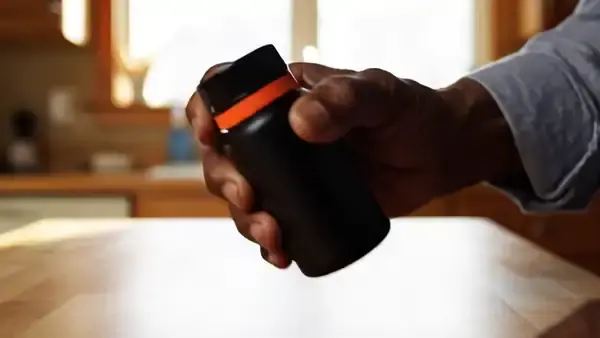
And this is what its 6:40 departure looks like on an ordinary counter: three shakes, a quarter turn of the cap, and two swallows.
10:00: The Hour to Notice Anything at All
On a timetable, a train is not judged at departure.
It is judged at the first station, when you can see whether it is on time.
For a morning bottle, the first station is the middle of the morning.
If the caffeine does anything you can feel, it will be somewhere between breakfast and lunch, and that is the hour to write a line in a notebook.
Not "sharper" or "foggier," which are words that mean whatever a man's frame of mind that day wants them to mean.
Write what you were doing at ten, how long it took, and whether you lost the thread of it.
Here is why that plain record matters more than any feeling.
In the citicoline memory trial I described, memory scores rose in the placebo group as well as in the citicoline group. [7]
In the three-year food trial I come to later, both groups improved, including the one that changed very little. [15]
People who are paying attention to their memory tend to do better on memory tests, whatever they swallow.
A man who starts watching his mornings will find they improve. That is not the bottle.
That is the reason a real trial has a placebo group, and it is the reason your own test needs a week without the bottle to compare against.
Six lines from the week before and six lines from the week of the bottle is the smallest honest comparison a man can make at home.
It will not be a trial, and it will not prove anything to anybody else.
It will tell you whether the bottle is worth a second carton, which is the only question you actually have.
10:00 is the first station on this timetable. Write down what happened, not how you felt, and keep the week before the bottle for comparison.
Why a Dispatcher Never Trusts One Good Morning
Every dispatcher learns the same lesson in his first winter.
One train that runs early proves nothing about the schedule.
Weather, a light load, a crew that knows the grade: a single good run has a dozen causes, and only one of them is the timetable.
The only thing that tells you about a schedule is a run of days, written down, compared with the days before.

A morning is the same.
A good night, a cool day, an easy task and a second mug of coffee can each make ten o'clock feel sharp.
So the first good morning with a new bottle is the one to trust least, because it is the one you most want to believe.
The sixth morning, set beside the week before, is the one to trust most.
I say this because the small bottles make it easy to fool yourself.
They are cold and sweet and new, and a new habit feels like progress on its first day whether it is or not.
One early train proves nothing, and one good morning proves nothing either. Six written mornings beside six ordinary ones is the least a fair test needs.
Noon: the Last Departure for Caffeine on This Timetable
Every railroad has a last train of the day, and after it the track is closed for maintenance.
On this label, the closing time is written in four words: "Do not use at bedtime."
The label does not say what hour bedtime is, so I set my own closing time much earlier.
Fifty milligrams is not a large amount, but caffeine is a slow passenger, and it is still aboard hours after it boards.
The federal caffeine page lists a bad night among the effects of too much caffeine. [1]
A man who drinks this bottle in the afternoon is scheduling half a mug of coffee into his evening without meaning to.
Before lunch, or not at all. That is my closing time, not the label's, and it is the stricter one.
There is one more reason to schedule it early.
If you want to know what this bottle does for you, you need a morning to notice it in, not a restless night to blame it for.
A timetable is only useful when it is predictable.
The same bottle, at the same hour, on the same kind of morning, is the only way to learn anything from six bottles.
Noon closes the track for caffeine on my timetable. The label says only "not at bedtime," and I would rather leave a wide margin than a narrow one.
The Evening Glass, and a Word-Fluency Test Over Thirty Years
The evening is not on the bottle's timetable at all, and that is exactly why I put it on mine.
The evening is where most men on this hill keep their other habit.

In 550 British civil servants followed for thirty years, the more a person drank, the faster their scores fell on a word-fluency test. [16]
Light drinkers had no advantage over the people who did not drink at all. [16]
That is an observation across a group of office workers, not a verdict on any one man's glass of wine.
But it is thirty years long, and nothing on this bottle's panel has a study even three months long in men my age.
If I were rearranging one departure on a man's day for the sake of his memory, it would be the evening glass, not the morning bottle.
That costs nothing, and it has three decades of data on its side.

The evening belongs to no bottle. Less in the glass after supper is the cheapest line on the whole timetable, and one of the best studied.
Two Panels on One Listing: the Carton in the Photographs Is Not the Carton in the Text
Now to the strangest thing I found.
In thirty-four years I saw plenty of schedules with two versions in circulation, and it never ended well until somebody pulled one of them.
The retailer's listing prints a panel in text, and that is the panel I have used on this page.
Caffeine at 50 milligrams, theanine at 200, citicoline and lion's mane at 250 each, the club moss at 10, and the two vitamins.
The maker's own product page, read the same week, lists the same ingredients.
So far, one schedule.
But the photographs of the carton on that same retailer's listing show a panel with different lines.
I read the photographs carefully, line by line, and here is what the carton in them prints that the text does not.
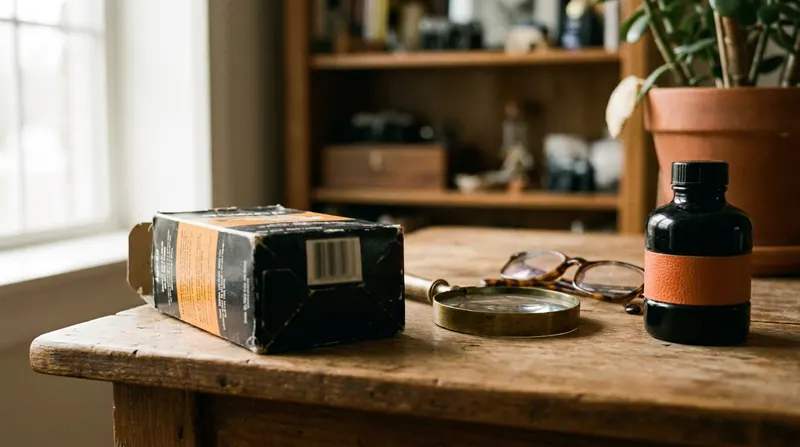
Two of those lines are not small corrections.
A gram of tyrosine and 300 milligrams of ashwagandha are whole ingredients, and they are on one version and missing from the other.
I do not know which carton will reach a buyer's door.
It may be that the photographs show an older version and the text shows the current one, since the maker's own page matches the text; but I cannot prove that, and I will not pretend I can.
What I can tell you is what a dispatcher would tell you: when two versions of a schedule are in circulation, you run by the one in your hand.
Read the panel on the carton that arrives, and take that panel, not this page, to the pharmacist.
It also matters for the theanine study I described earlier.
If your carton prints 100 milligrams of theanine, your bottle matches that study's pair exactly; if it prints 200, it carries twice the theanine. [3]
The two missing lines on the printed panel matter at the pharmacy counter as well.
If your carton prints the tyrosine and the ashwagandha, those are two more names for the pharmacist to read, and they belong on the same list as the club moss.
Two panels for one product on the same retailer's page, one with two ingredients the other does not list. The carton in your hand is the only panel that counts.
The Brand's Own Trial Ran on Its Capsules, in Adults Under Thirty-Six
Two more pieces of fine print, and then I will get to the part of the timetable that costs nothing.
The first is about the words on the front of the carton.
The carton says it supports memory and focus.
The maker's own website has a table comparing its products.
In that table, this bottle is listed for focus and energy, and memory sits beside the capsules instead.
I am not saying the carton is wrong and the website is right.
I am saying the maker describes this bottle two ways in two places, and a careful reader should notice.
The second piece of fine print is about the one trial with the brand's name on it.
That trial did not test this bottle.
It is a real trial, properly registered, of a different product, in people young enough to be my grandchildren.
A trial of the capsules is not a trial of the bottle. It is not even a trial of the same recipe.
Nobody has tested this bottle, and nobody has tested any version of it in men over 55.
That is not a scandal; most products on any shelf have never been tested as themselves.
But it means every judgment on this page is built from the parts, line by line, and not from the whole.
That is the only honest way to read this label, and it is why I have been so careful with the doses.
Fourteen Ratings, an Average of 4.4, and No Quotations
The retailer's listing shows fourteen customer ratings for this carton, with an average of 4.4 stars.
Nine are five stars, four are four stars, none are three or two, and one is a single star.
Every one of the fourteen carries the retailer's purchase mark.
That is a good sign, and fourteen is still a small number of riders for any train.
I am not quoting any of them, and the reason is simple.
The store served the reviews to me only in an automatic Spanish translation, so I cannot give you any buyer's words exactly as that buyer wrote them.
A translated quotation is not a quotation.
I would rather give you the count, the stars and nothing else than put words in a stranger's mouth.
Fourteen ratings tell you how fourteen buyers felt about a cold peach drink with caffeine in it. They cannot tell you what the other five lines did.
The Cheaper Lines on the Same Timetable
A good dispatcher knows that most delays are not caused by the big trains.
They are caused by the small things nobody scheduled: a switch nobody checked, a crew nobody called.
A man's morning is the same.
Before I would schedule a bottle into it, I would check three small things that cost almost nothing and have more behind them than anything on this panel.
The first is a glass of water.
In the Berlin Aging Study, older adults who were measurably short of water showed a steeper drop over time on a test of processing speed. [18]

A review of eighteen studies in older people found some evidence, though sparse, tying low water intake to poorer thinking scores. [19]
Sparse is the honest word, and it is still more than the lion's mane line on this bottle can claim at its dose.
The second is the plate.
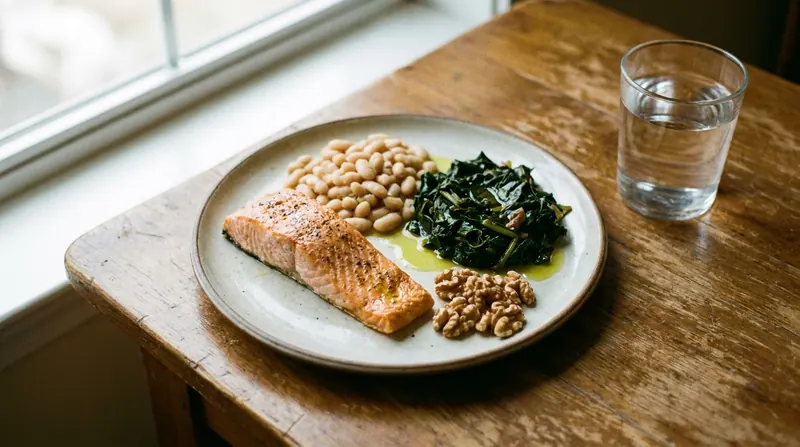
In a three-year trial of 604 older adults, one group ate the MIND pattern: vegetables, berries, nuts, whole grains, beans, fish and olive oil. [15]
The other group kept its usual diet with slightly fewer calories, and the thinking scores of both groups rose by about the same amount. [15]
That tells me the pattern is not a special menu, and it also tells me that paying attention to what is on the plate moved both groups in the right direction.
On the other side of the ledger, a Brazilian study followed 10,775 adults for eight years. [20]
Those who ate the most ultra-processed food lost ground on thinking tests about a quarter faster than those who ate the least. [20]
That is an association across a population, not a sentence on any one breakfast.
But the direction is plain: fewer packaged snacks, more ordinary food cooked at home.
The third is the B12 test I mentioned earlier.
If you are past 65 and have never had your B12 checked, that one blood test answers a question this whole panel can only guess at. [12]
Water, the plate and one blood test. Three switches worth checking before any new train runs.
None of these three lines is in the bottle, and all three are on the same timetable. They cost less than the carton and have more behind them than most of its panel.
The Carton's Paperwork: a Date, a Code and One Sentence in Small Type
Every train carries paperwork, and I always read it before I read the cargo.
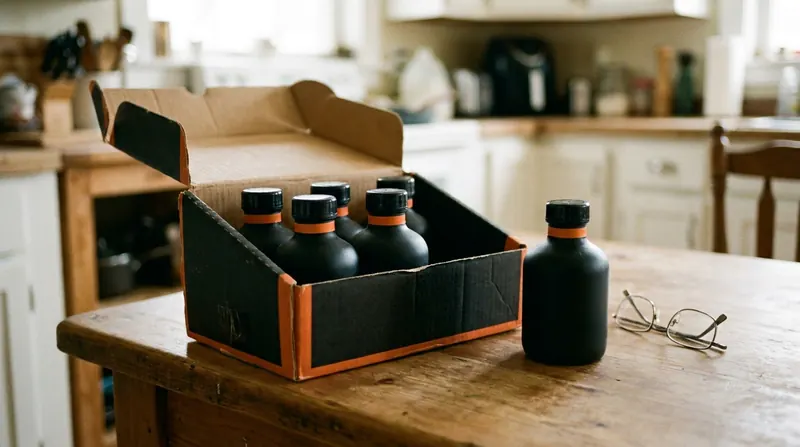
This carton has three pieces of paperwork worth a minute.
The first is a date.
The retailer's listing gives a best-by month for its current stock, April 2027, which is a long way off for a carton of six.
The second is a code.
The listing gives the carton its own product code and a barcode number, which is how you make sure the carton at your door is the same one the listing describes.
The third is the sentence every American dietary supplement carries in small type.
It says the statements on the carton have not been evaluated by the Food and Drug Administration, and that the product is not intended to act on any health condition.
I do not read that sentence as a fault in the carton; I read it as the most honest line on it.
It tells you what kind of product this is, and what kind of promise a product of this kind is allowed to make.
A drink with a Supplement Facts panel is not a soda and not a medicine.
It sits on the supplement shelf, under supplement rules, and the carton's own paperwork says so plainly.
A date far enough off, a code to match against the listing, and one sentence in small type that tells you exactly what shelf this carton belongs on.
Six Things a Small Peach Bottle Will Not Do
Every timetable I ever wrote had a list of what the line could not carry.
Here is this bottle's.
- It will not come with a trial of itself. The one trial with the brand's name tested its capsules, in adults 18 to 35.
- It will not bring lion's mane to its trial dose. Two hundred fifty milligrams against 3.2 grams a day.
- It will not do more for alertness than its caffeine does. Its clearest effect is half a mug of coffee's worth.
- It will not ride alongside the brand's capsules. The label says one bottle in twenty-four hours and no other Alpha BRAIN product.
- It will not act on any health condition a clinician has named. It is a dietary supplement, and its carton carries the sentence that says so.
- It will not tell you which panel is in your carton until it arrives. Read it then.
If that list is disappointing, I would rather you felt it now than on the sixth morning.
An empty carton and no idea which line did anything is the worst way to finish a test run.
A Six-Morning Timetable, If You Decide to Run One
If you are going to try it, run it the way a railroad runs a new service.
A fixed time, a fixed route, a written log, and a decision at the end.
- Before the first bottle, take the carton to the pharmacist with everything else you take, and ask about the club-moss line by name.
- Read the panel on the carton that arrives. The theanine, the caffeine source and two whole ingredients depend on which panel you get.
- Set the bottles in the refrigerator door the night before. The label says to serve it chilled and to shake it well.
- Drink one bottle at the same hour each morning, before lunch. Never two in a day, and never with the brand's capsules.
- Count it with your coffee. Fifty milligrams added to whatever is already in the mug.
- Write one line a day in a pocket notebook: what you were doing at ten, and how it went.
- On the seventh morning, read the six lines beside six lines from the week before. That is the only trial of this bottle you will ever run.
Look at that list the way I would.
Six of the seven steps cost nothing at all.
This bottle is worth a look if:
- You want a small, measured amount of caffeine in a bottle you can take from the refrigerator door.
- You have read that theanine and citicoline sit at the doses of small trials, and that lion's mane does not.
- You will take the carton to the pharmacist before the first bottle and ask about the club moss.
- You will keep it to one bottle a day, before lunch, apart from the brand's capsules.
Leave it on the shelf if:
- You take anything daily that the pharmacist says pulls against the club-moss line.
- You are sensitive to caffeine, or you already drink three large mugs by noon.
- You want a trial of this bottle in men your age. There is none.
- You were hoping for the lion's mane dose of the trial. It is a thirteenth of it.
Where the Carton Is Sold, and What the Listing Leaves to You
The carton is sold on iHerb, a large online retailer, and that is the only store this page links to.
The seller is iHerb, LLC, of Irvine, California, which publishes a street address and a customer-support email.
The maker, Onnit Labs, is in Austin, Texas, and its name is on the carton.
The retailer's listing says returns and refunds follow its own posted policy, and this page makes no promise beyond what that policy says.
The price is the one on the listing on the day you look.
This page prints none, because the listing sets it by country and it changes.
Look at the price and at the shipping line for your own address before you decide, the way you would check a fare before boarding.
And when the carton arrives, read its panel before you open the first bottle.

One carton, six mornings, and the pharmacist first
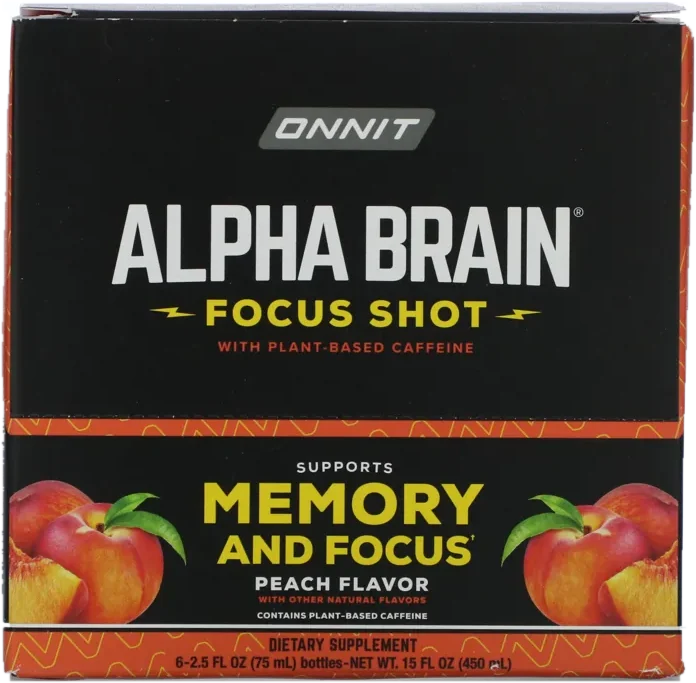
A 2.5-ounce peach bottle from Onnit of Austin, Texas: 50 milligrams of caffeine, 250 of citicoline, 250 of lion's mane, 200 of L-theanine and a tenth of a milligram of huperzine A, one bottle a day.
LOOK UP THE SIX-BOTTLE CARTONSold by iHerb, LLC, Irvine, California · made for Onnit Labs of Austin, Texas · six 2.5 fl oz bottles · one bottle in 24 hours, not at bedtime · 50 mg of caffeine a bottle
Questions asked on the platform
Is this a medicine?
No. It is a dietary supplement in the form of a drink, and its carton carries the standard sentence saying its claims have not been evaluated by the Food and Drug Administration.
How much caffeine is in one bottle?
Fifty milligrams, which the label calls half a cup of coffee. A 12-ounce cup of brewed coffee runs from 113 to 247 milligrams. [1]
What time of day makes sense?
The label says only "not at bedtime." I would drink it before lunch and at the same hour every morning.
Will it help my memory?
Nobody has tested this bottle, and the brand's one trial tested its capsules in adults under 36. [17]
The caffeine will make you more alert for a while, and two of the other lines sit at the doses of small trials.
Why the pharmacist?
The club-moss line slows an enzyme that some daily medicines also act on. The pharmacist should see the carton with everything else you take. [11]
Can I drink it with the Alpha BRAIN capsules?
The label says no. The capsules carry the same club moss.
Why do the photographs show a different panel?
The listing's printed panel and the carton in its photographs do not match. Read the panel on the carton you receive.
Are there reviews?
Fourteen ratings on the listing, averaging 4.4 stars. None is quoted here, because the store served them only in translation.
The Whole Timetable on One Card
- The night before: six bottles in the refrigerator door, one set aside, the rest left alone.
- 6:40: shake it three times, because some of what is in it settles, which the maker calls normal.
- 7:00: count its 50 milligrams of caffeine with your coffee, against a 400-milligram day. [1] [2]
- The pairing: 50 milligrams of caffeine with theanine has one small one-hour study behind it. [3]
- Theanine: 200 milligrams on the printed panel, the dose of a four-week trial in 30 adults around 48. [4]
- Citicoline: 250 milligrams, the dose of a 28-day attention trial, and half of a memory trial's dose. [6] [7]
- Lion's mane: 250 milligrams, about a thirteenth of the 3.2 grams a day of its trial. [9]
- Club moss: a tenth of a milligram of huperzine A, for the pharmacist before the first bottle. [11]
- B12 and B6: ordinary vitamins, a blood test being the real answer on B12. [12] [14]
- Noon: my closing time for caffeine, stricter than the label's bedtime rule.
- The fine print: two panels on one listing, and a brand trial of the capsules in adults 18 to 35. [17]
The Last Line in the Book
A good timetable is the one nobody has to think about once it is running.
That is what I would want from any bottle on my counter: a fixed hour, a known number, and no surprises on the track.
When I retired, the railroad gave me a watch, which is the kind of joke railroads like.
I still wind it every morning, and I still write down anything I intend to do on a schedule.
Here is this bottle, written as I would have written it for the board.
A small, cold, measured half mug of caffeine, which works, and two lines at the doses of small trials, which is more than many panels can say.
A mushroom at a thirteenth of its trial.
A club-moss line that acts on a body enzyme and needs the pharmacist's two minutes.
A listing whose photographs and printed panel disagree, and a brand whose one trial tested something else, in people under 36.
And a label that, to its credit, tells you its rules in plain words: one a day, alone, and not at night.
If you are a man who wants a small, measured amount of caffeine with a couple of reasonable lines beside it, who will show the carton to the pharmacist and keep to the label's clock, one carton is a fair test run.
Not because of the stars, and not because of the words on the front.
Because you will know exactly what is on the track, at what hour, and how far each line sits from its trial.
That is all a timetable ever promised anybody, and it is enough.
Show the carton to the pharmacist, set the bottles in the cold the night before, drink one before lunch and never with the capsules, count it with your coffee, and write one line a day.
The carton, if it earns a place on your timetable
A 2.5-ounce peach bottle from Onnit of Austin, Texas: 50 milligrams of caffeine, 250 of citicoline, 250 of lion's mane, 200 of L-theanine and a tenth of a milligram of huperzine A, one bottle a day.
LOOK UP THE SIX-BOTTLE CARTONiHerb, LLC, 17400 Laguna Canyon Rd, Irvine, California · customer support by email · made for Onnit Labs of Austin, Texas · read the panel on the carton you receive
P.S. If you keep one number from this page, keep fifty.
Fifty milligrams of caffeine, written on the same line as your morning coffee.
P.P.S. If the forgetting has been with you for a year, and it is there before the coffee as well as after, talk to your own clinician before you buy anything.
A small bottle was never going to answer a question that a clinician and a blood test answer in one visit.
Every line of the panel, with its plain English name, its dose, the trial behind it and who paid for that trial, is written out in the ingredient and advertising guide linked at the foot of this page.
The guide also explains the club-moss line for the pharmacist and lists both panels side by side.